16 October 2026 Maciej Łobos
Piano learning for beginners – How to start wisely and not lose motivation?
Starting to learn an instrument is a process that requires patience, consistency, and dedication. The piano is no exception. Although this journey can be long, it brings extremely rewarding and long-term results that enrich life on many levels.
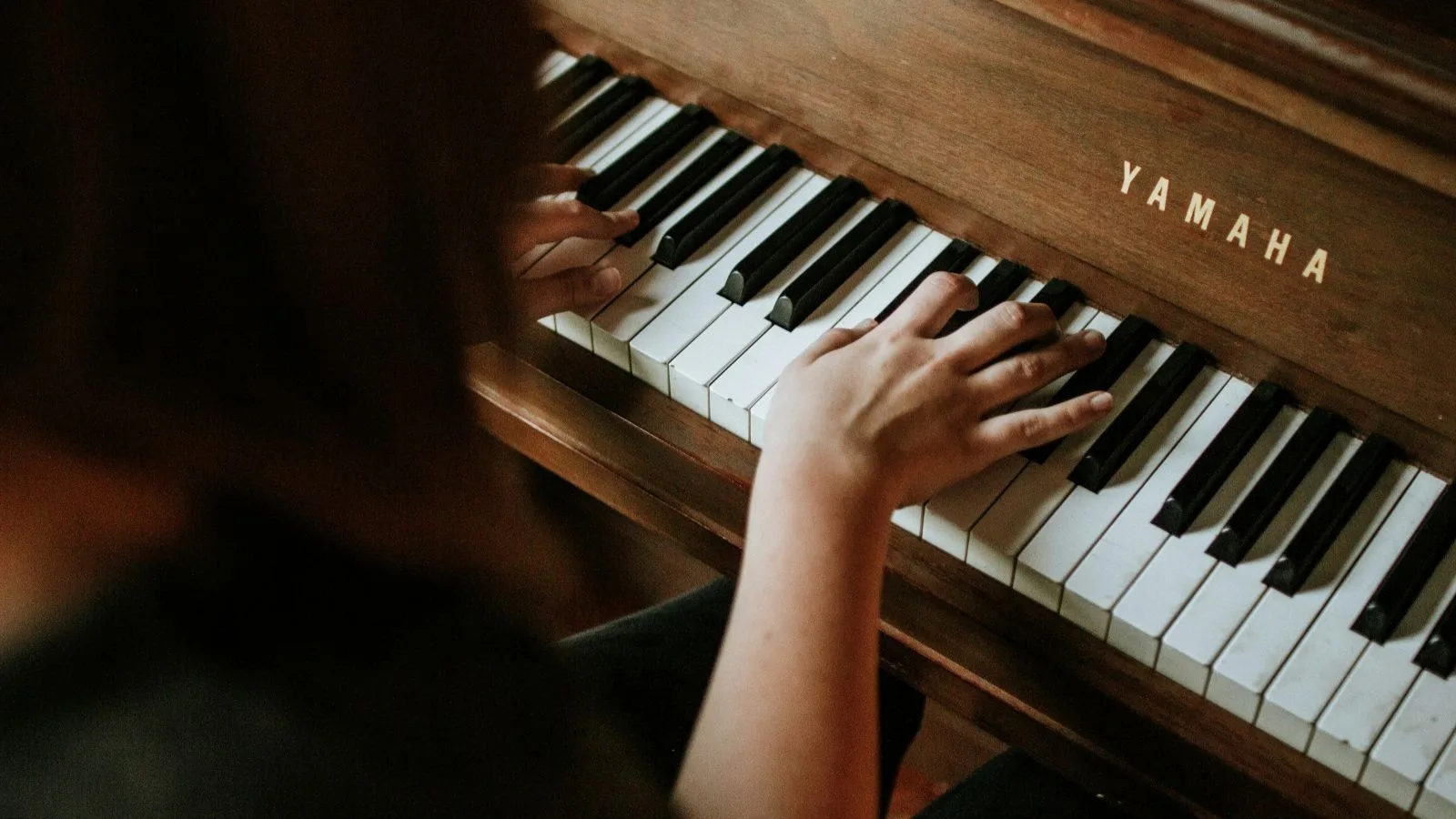
The key to success - especially at the very beginning - is choosing the right repertoire. To avoid getting discouraged with the instrument, it is best to start with pieces that are melodic, rhythmically simple, and do not require complex hand coordination, such as those where the left hand provides a sparse bass accompaniment and the right hand leads with a clear melody.
Why do we give up, and how to prevent it?
It is no secret that many learners especially children - quit lessons after just a few months. A common cause is the lack of immediate results expected by both the students themselves and their parents. Unfortunately, music education is inherently time-consuming. Noticeable progress is the result of several factors: the student’s individual predisposition, the regularity and quality of practice at home, and the competence of the teacher. If after some time you feel stuck in a rut, an honest conversation with your teacher becomes crucial. It is worth jointly revising your goals, discussing any difficulties encountered, and setting smaller, measurable milestones. Discouragement is a natural stage that can be overcome with the right practice structure.
The value of music in a young person’s development
Regardless of whether we treat playing the piano as a hobby or an investment in the future, music has a powerful impact on the personality development of children and teenagers. Regular contact with the instrument stimulates:
Creativity and imagination - through the interpretation of pieces and improvisation.
Empathy and sensitivity - by learning to receive the emotions embedded in sounds.
Diligence, reliability, and systematic work - as the foundation of any progress.
Focus and problem-solving skills - required when analyzing complex sheet music.
Different paths of education: Children vs. Adults
The teaching methodology must be strictly tailored to the age and worldview of the student. Working with a preschool or early school-aged child is completely different from working with an adult.
Education for the youngest: Children aged 4-6 quickly lose interest if they are overwhelmed with theory, sheet music, and abstract concepts of the staff on their very first lesson. For them, learning should take place through play, musical puzzles, and physical activity. Before deciding to work with a specific teacher, it is worth asking about their proprietary work plan for children to ensure the lessons will be engaging and free from unnecessary pressure.
The adult approach: Adults approach education in a more pragmatic and task-oriented way. They need clear, structured information about theory - what rhythm is, how a melody is constructed, or how to correctly read notes in the treble and bass clefs. The beginnings of learning the piano for adults are largely about consciously building a memory and technical foundation.
What pieces to choose at the start? Avoid the "too difficult repertoire" trap
One of the most common mistakes made by beginner pianists is jumping straight into advanced masterpieces that require perfect hand independence and an advanced knowledge of music theory. Trying to tackle a piece beyond our current capabilities usually leads to frustration, bad habits, and abandoning the instrument for weeks. The best practice is a gradual increase in difficulty. At the beginning, it is worth choosing pieces that engage each hand individually so that the fingers gain precision and strength in pressing the keys. Only when both hands cope comfortably in solo mode can you proceed to their coordination. Basic theoretical knowledge is also essential - familiarity with musical clefs, rhythmic values, and accidental signs (sharps and flats). Proven didactic materials, including the valued textbooks by Ludmiła Bas, are helpful in mastering this knowledge.
Classical repertoire for beginners: From Bach to Chopin
Once you have mastered the basics and want to tackle piano literature by the greatest composers, it is worth reaching for selected, shorter, and more accessible forms.
1. Frédéric Chopin
Chopin’s work is considered extremely demanding, full of subtlety, rubato, and technical traps (such as polyrhythm, where the right and left hands divide time differently). Nevertheless, after 6-12 months of regular practice, you can safely reach for his miniatures:
Waltz in A minor (WN 19 / KK IVb/11 - the so-called posthumous waltz): Although it requires dexterity, it enjoys immense popularity. The right hand leads a fast yet repetitive motif, while the left executes a classic dance pattern (bass-chord). This provides immense performance satisfaction.
Polonaise in G minor (B. 1): Composed by a mere seven-year-old Chopin. It is technically simple, has a distinct march-like character, and teaches rhythmic discipline.
Preludes (e.g., Op. 28 No. 4 in E minor, No. 7 in A major, No. 6 in B minor): These miniatures are an excellent starting point. The E minor Prelude is based on a singing melody and minimalist accompaniment, where the main challenge is not technique, but operating the mood (cantabile). The A major Prelude teaches lightness of touch.
2. Johann Sebastian Bach
Minuet in G major (BWV Anh. 114): An absolute educational classic. It teaches fundamental hand independence, and its logical structure makes it easier to memorize phrases.
3. Ludwig van Beethoven
Für Elise (Bagatelle in A minor) - opening motif: Although the entire composition can be complex, its famous opening motif is surprisingly accessible and lets you feel a sense of satisfaction after just a few weeks of practice.
4. Wolfgang Amadeus Mozart
Turkish March (simplified versions/fragments): An excellent piece for developing a sense of rhythm and articulatory precision while maintaining a moderate level of arrangement difficulty.
Remember that every master started somewhere. The key to success is patience, regularity, and taking joy in every single new sound :)